
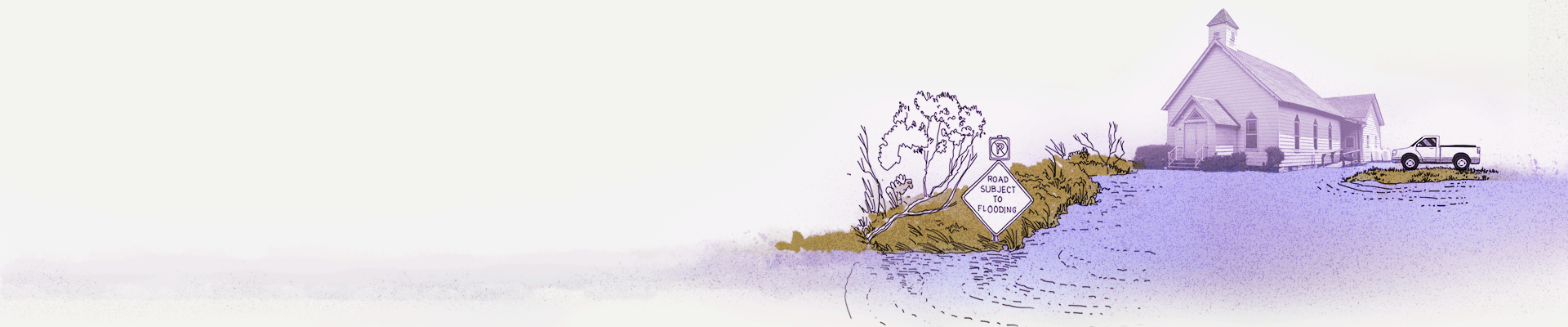
What’s the problem with road flooding?
When roads flood, people are delayed getting to work, school, medical appointments, or evacuation points in Maryland. Neighborhoods can be cut off from emergency help during storms, and infrastructure can be damaged because of flooded roads. Roadway flooding is not just an inconvenience, it is a serious safety risk.
What causes road flooding?
Flooding is caused by storm surges and rainfall. Intense rainstorms are expected to become more frequent and more severe on the Eastern Shore, and it takes just inches of water to make a road too dangerous to drive.
What does this mean for the future?

By 2043, storm surge may happen 20-50% more often, and around 60 businesses on the Shore could be affected if the storm surge reaches over 3 feet high.
By 2060, road flooding may increase 9-13% and affect an extra 180 miles of local roads.
By 2080, another 60 miles will be easily flooded.
Oyster saw a nine-foot storm surge during Hurricane Isabel in 2003. Its shoreline and tidal creeks make inland flooding easier.
By 2043, similar storms could raise flood levels by two feet, threatening areas that stayed dry before. Storm surge is likely to reach up to the town of Bayside, which is close to several creeks. The Bayside areas further from creeks are likely to experience less than three feet of storm surge.
What can be done?

PRIORITIZE FREQUENTLY FLOODED AREAS FOR MAINTENANCE
Some communities and roads are more likely to flood than others. Roads may flood more often if they are downhill from paved areas or in places where culverts are blocked. The municipal government can prioritize these areas for drainage upgrades, culvert clearing, and emergency response systems.
CAPTURE WATER AND SLOW IT DOWN
Homeowners can build rain gardens with native plants to catch water and let it sink in. Berms, or small earth mounds, can help catch and direct water to sink into the ground on your property. The Virginia Conservation Assistance Program provides grants to replace hard driveways with permeable pavers and install landscaping to capture rainwater. Find out more at https://vaswcd.org/landowner-vcap-landing/.

ELEVATE ROADS
Putting some roads on higher ground may keep them from flooding as frequently during ordinary rain events.
ABANDON UNNECESSARY ROADS
If a road is not the only way to get to place and it is frequently flooded, the road could be discontinued. Planning access roads in less-flooded areas is best.
Livability Tool Research
The science team investigated how flooding affects roads to give decision-makers tools for transportation planning. This data is available in the interactive Livability Tool.
Resources
Building rain gardens
Virginia Cooperative Extension Stormwater Management Guides
- Rain barrels: https://www.pubs.ext.vt.edu/content/dam/pubs_ext_vt_edu/spes/spes-10/SPES-609.pdf
- Grass swales: https://www.pubs.ext.vt.edu/SPES/SPES-12/SPES-12.html
- Buffers https://www.pubs.ext.vt.edu/SPES/SPES-14/SPES-14.html
- Rain Gardens:https://www.pubs.ext.vt.edu/SPES/SPES-13/SPES-13.html
- Permeable Paving: https://www.pubs.ext.vt.edu/content/dam/pubs_ext_vt_edu/spes/spes-11/SPES-610.pdf
- Rooftop redirection: https://www.pubs.ext.vt.edu/SPES/SPES-9/SPES-9.html